
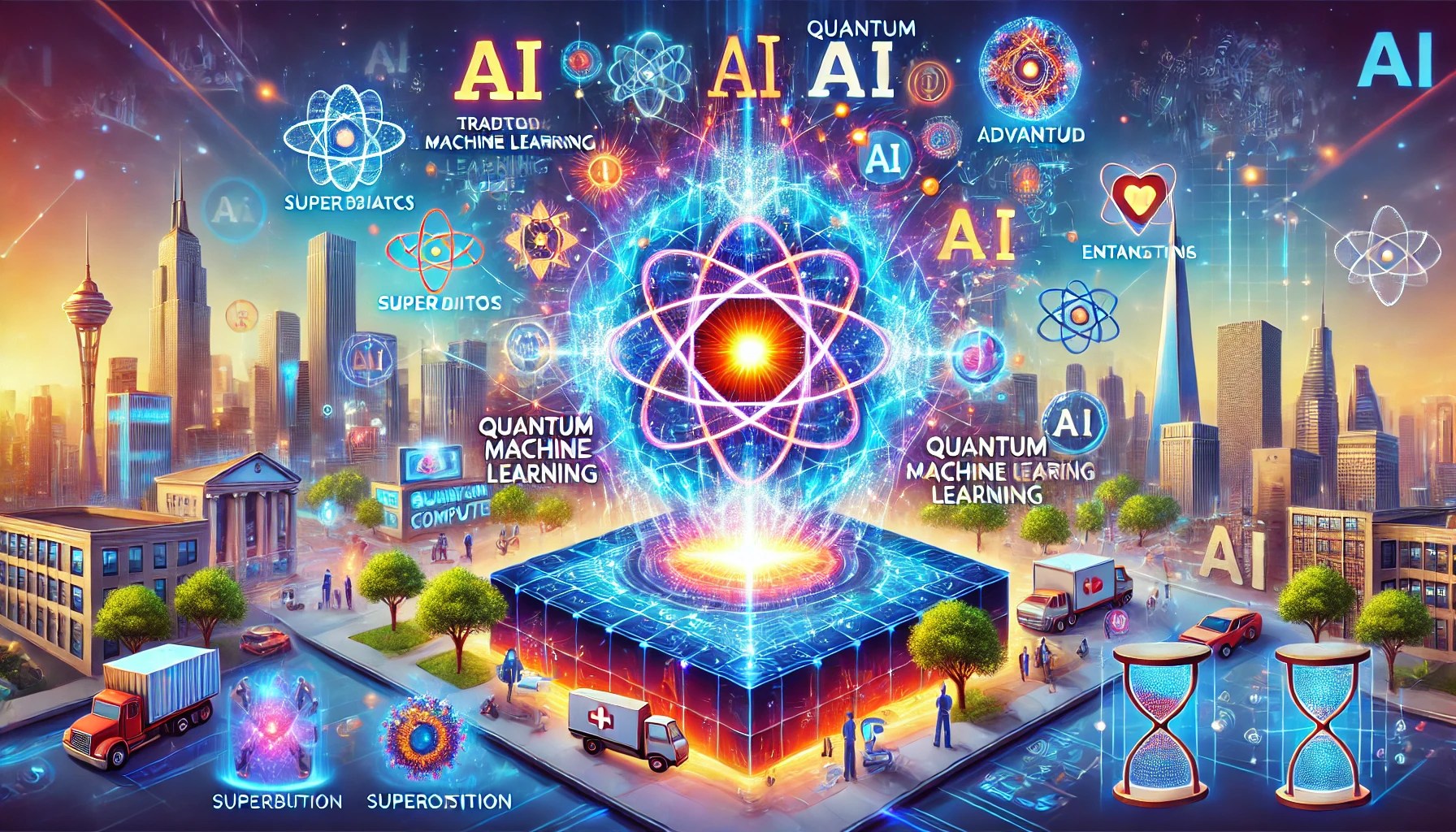
Imagine a world where your virtual assistant is so smart that it can understand and predict your needs with incredible precision. A world where medical diagnoses are swift and pinpoint accurate, and where complex problems are solved in the blink of an eye. This isn’t a scene from a sci-fi movie; it’s the potential future thanks to Quantum Machine Learning (QML).
A Glimpse into Quantum Machine Learning
In the realm of AI, a fascinating development is unfolding. It’s called Quantum Machine Learning, and it’s like giving AI a superpower. To understand QML, let’s first talk about how computers work. Traditional computers use bits, which are like tiny switches that can be either on or off (0 or 1). Quantum computers, on the other hand, use qubits. Due to the peculiar principles of quantum physics, these qubits can be in multiple states at once. This ability is known as superposition.
Another amazing feature of qubits is entanglement. When qubits become entangled, the state of one qubit can depend on the state of another, no matter how far apart they are. These properties allow quantum computers to process vast amounts of data simultaneously and solve complex problems much faster than classical computers.
Why QML is a Game Changer
Think of QML as a turbo boost for AI. Traditional AI algorithms work well, but they can struggle with large, complex datasets. QML enhances these algorithms, making them faster and more accurate. This means that tasks like recognizing patterns, classifying data, and making predictions can be done more efficiently.
Interdisciplinary Magic
QML is a beautiful blend of quantum physics, computer science, and artificial intelligence. It brings together the best of these worlds to create powerful new algorithms. For example, the Quantum Approximate Optimization Algorithm (QAOA) and the Variational Quantum Eigensolver (VQE) can solve problems that were previously too complex for classical computers. These algorithms help build more advanced machine learning models that can perform tasks like classification and clustering more effectively.
New Algorithmic Horizons
With QML, new types of algorithms are emerging. Quantum Neural Networks (QNNs) and Quantum Support Vector Machines (QSVMs) are some examples. QNNs, inspired by classical neural networks, use quantum mechanics to process information differently, potentially speeding up training and inference. QSVMs leverage quantum principles to analyze data more deeply, improving the separation of complex patterns.
Tackling the Big Data Challenge
One of the biggest hurdles in machine learning is handling high-dimensional data, which can be like finding a needle in a haystack. Quantum computers, with their parallel processing capabilities, can manage these massive datasets efficiently. Techniques like Quantum Principal Component Analysis (QPCA) and Quantum Boltzmann Machines (QBM) can tackle problems that are too challenging for classical systems, offering scalable solutions.
Ensuring Reliability
Quantum computing is still in its early stages, and one of the main challenges is dealing with errors. Quantum Error Correction (QEC) and fault-tolerant computing are essential to ensure that quantum algorithms are reliable and accurate. These advancements are crucial to harnessing the full potential of QML.
Real-World Applications
This isn’t just theoretical. Companies across various sectors are already experimenting with quantum algorithms to enhance their products and services. From pharmaceuticals to finance, the potential applications are vast and transformative.
Ethical Considerations
As with any powerful technology, ethical concerns are important. Issues like data privacy, security, and the societal impact of AI need careful consideration. Quantum cryptography, combined with QML, can offer enhanced security measures, protecting sensitive data and ensuring trust in AI systems.
The Road Ahead
Quantum machine learning is poised to revolutionize the AI landscape. By merging the power of quantum computing with AI, we can solve some of the most challenging problems in ways we never thought possible. As we move forward, staying informed and embracing these advancements will be key to creating a smarter, more efficient, and secure future. Imagine the possibilities—a world where AI is not just intelligent, but extraordinarily powerful, making our lives better in countless ways. The future of AI is bright, and Quantum Machine Learning is leading the way.
~Rai
 An Observer
Nice
LikeLiked by 1 person
I am glad you liked it. 🙂
LikeLike